Games
Multi-agent interaction
Up to this point:
- Stochastic Uncertainty
- Optimization
This week:
- Interaction Uncertainty
- Game Solution Concepts

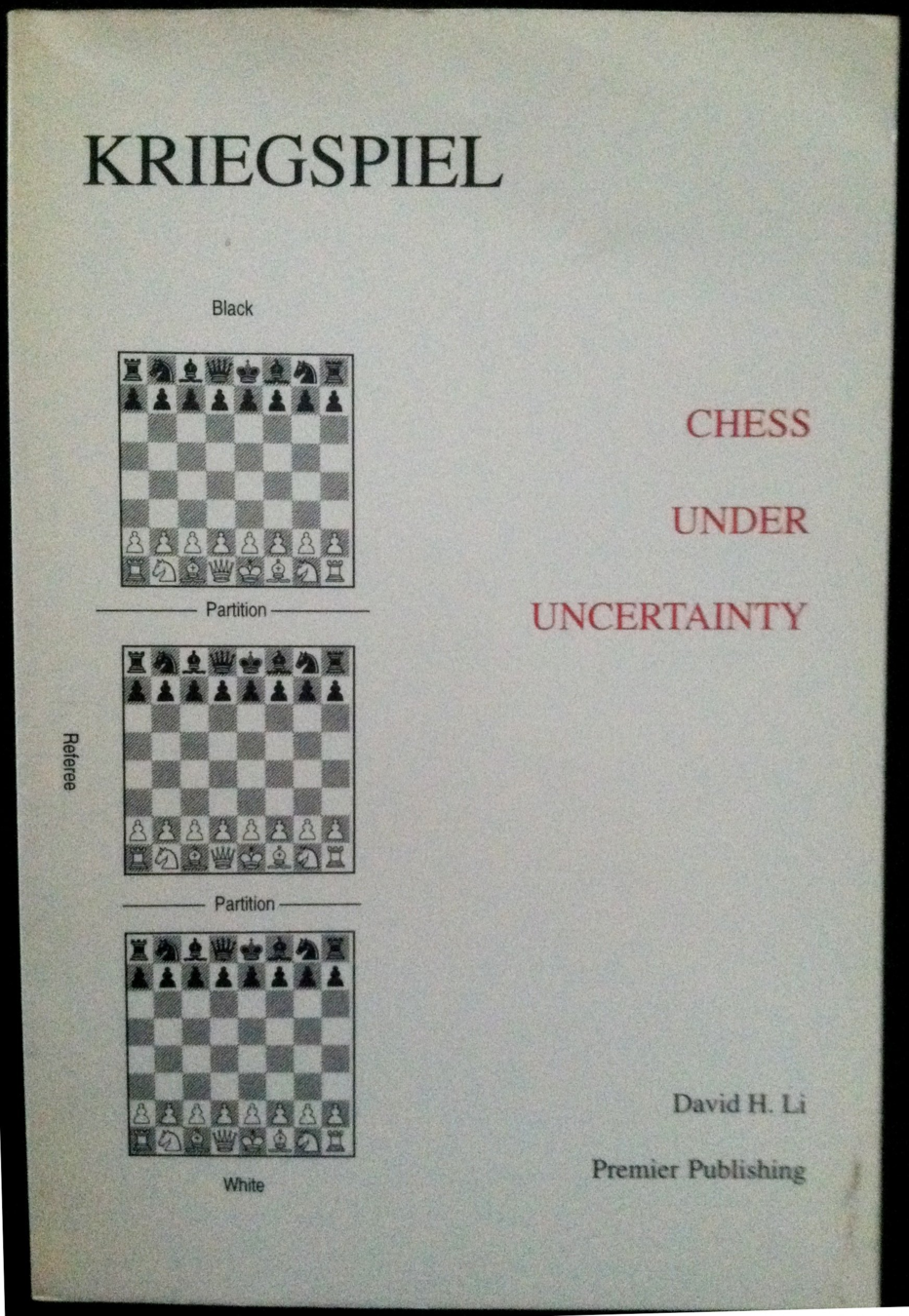
Kriegspiel

Outline
- Matrix Games
- Linear Programming
- Regret Matching
- Turn-taking Games
- Minimax Trees
- \(\alpha\)-\(\beta\) Pruning
- Monte Carlo Tree Search
- Imperfect Information Games
- Extensive-form Games
- Counterfactual Regret Minimization
Sources:
- AI: A Modern Approach by Russel and Norvig
- "An Introduction to Counterfactual Regret Minimization in Games" by Neller and Lanctot
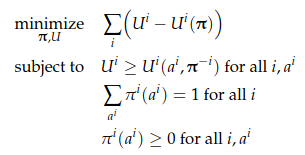
Game Solution Concepts: Nash and Correlated Equilibria
Battle of the Sexes
Rock Paper Scissors
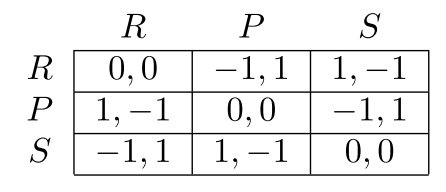
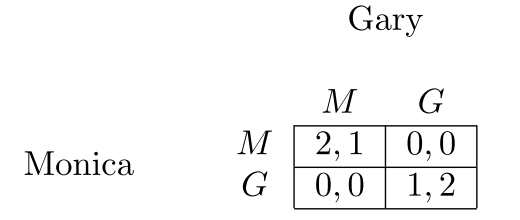
Definitions:
- Strategy/Policy: Probability distribution of actions for a player
- Strategy Profile: Set of strategies for all players
- Nash Equilibrium: A strategy where there is no incentive for any player to unilaterally change strategy
- Correlated Equilibrium: Strategy profile with a shared random source
Calculating Mixed-Strategy Equilibria
By hand
\[\sigma_\text{Gary}(M) = x\]
\(U_\text{Monica}(\sigma_\text{Gary}, M) = 2x\),
\(U_\text{Monica}(\sigma_\text{Gary}, G) = 1-x\)
If \(x=1/3\), these are equal, so Monica is indifferent. By symmetry, \(\sigma = \{(\frac{2}{3},\frac{1}{3}), (\frac{1}{3},\frac{2}{3}\}\) is a Nash Equilibrium.
Regret Matching
For action profile \(\mathbf{a}\), player \(i\)'s regret for not playing action \(a'\) is: \[R(a'_i) = U(a'_i, a_{-i}) - U(\mathbf{a})\] that is, the utility missed out on by not playing \(a'\).
Positive regret means that action would have been better.
Regret Matching:
For some number of iterations:
- Compute a regret matching profile (\(\sigma \propto \text{normalized cumulative regret}\))
- Add strategy profile to profile sum
- Select an action
- Compute regrets
- Add regrets to cumulative regrets
Turn-taking Games
Terminology
- Max and Min players
- deterministic
- two player
- zero-sum
- perfect information

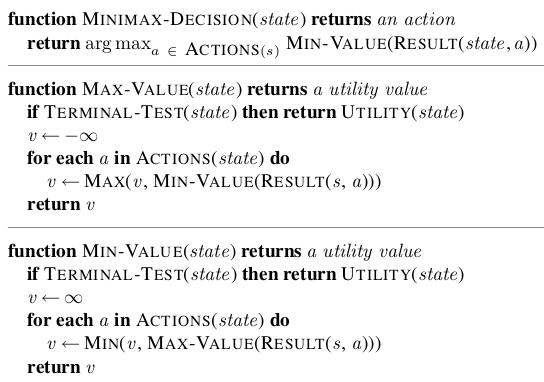
Minimax Trees
Minimax Tree
MDP Expectimax Tree
\[V(s) = \text{max}_{a \in \mathcal{A}}\left(R(s, a) + \text{E}[V(s')]\right)\]
\[V_1(s) = \text{max}_{a \in \mathcal{A_1}}\left(R(s, a) + \text{min}_{a' \in A_2} (R(s', a') + V(s''))\right)\]
Tree Backup Example
Why is this harder than an MDP? (think back to sparse sampling)
Alpha-Beta Pruning

Evaluation Functions
Examples of evaluation functions:
- Rollout using default policy
- Neural Network
- Weighted combination of features (e.g. number of Pawns, Knights, etc.)
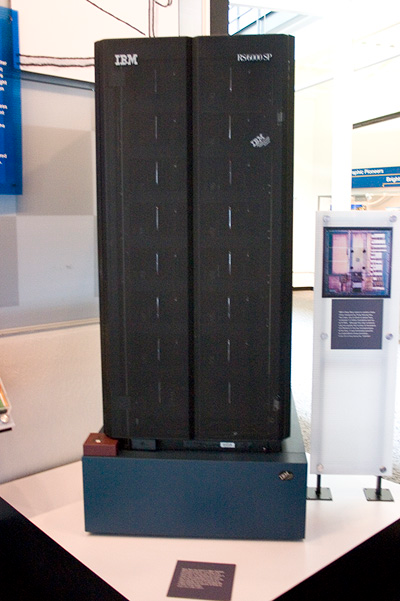
Deep Blue
- Defeated world champion Gary Kasparov in may 1997
- 30 IBM RS/600 processors for alpha-beta search
- Routinely reached depth 14, sometimes up to 40
- Evaluation function with 8000 features
- Opening book of 4000 positions
- Database of 700,000 grandmaster games
MCTS for Games

Break Exercise
- Start at 5
- Max can move up/down
- Min moves left/right
- Each player gets 2 turns
- On green squares, Max wins
- Who has advantage and what is first move?
Bonus: what if 5 was not green?
Incomplete Information

Incomplete Information
Incomplete Information
Extensive-form game definition (\(h\) is a sequence of actions called a "history"):
- Finite set of \(n\) players, plus the "chance" player
- \(P(h)\) (player at each history)
- \(A(h)\) (set of actions at each history)
- \(I(h)\) (information set that each history maps to)
- \(U(h)\) (payoff for each leaf node in the game tree)
King-Ace Poker Example
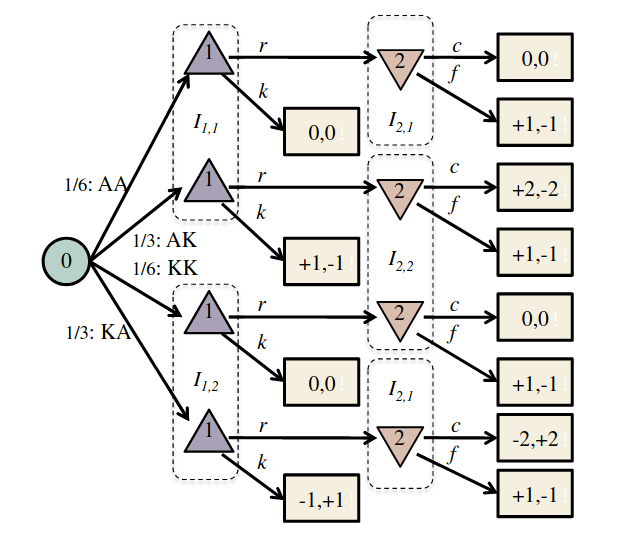
- 4 Cards: 2 Aces, 2 Kings
- Each player is dealt a card
- P1 can either raise (\(r\)) the payoff to 2 points or check (\(k\)) the payoff at 1 point
- If P1 raises, P2 can either call (\(c\)) Player 1's bet, or fold (\(f\)) the payoff back to 1 point
- The highest card wins
Extensive to Matrix Form

Exponential in number of info states!
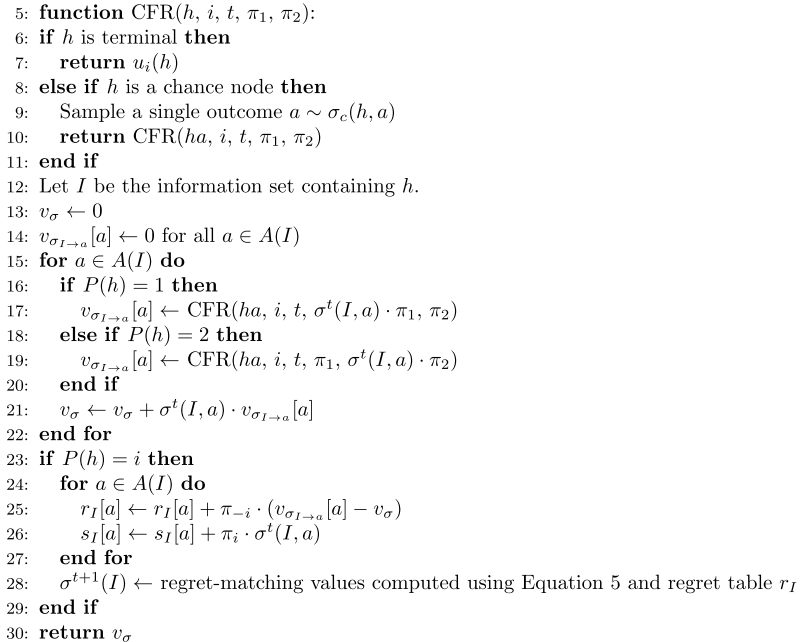
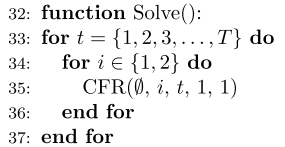
Counterfactual Regret Minimization

Kuhn Poker Example
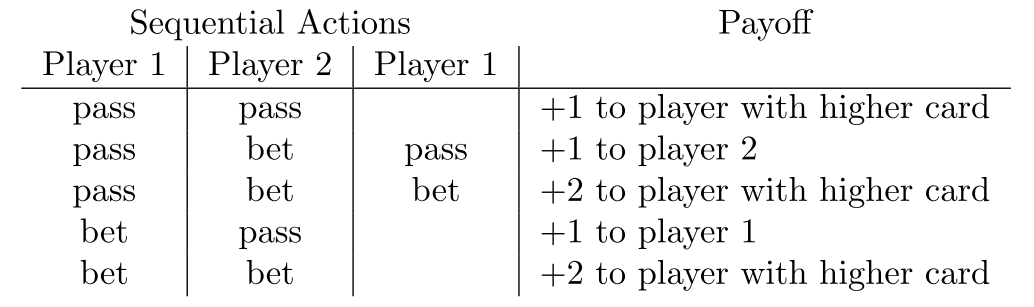
3 Cards: 1, 2, and 3
Solution (found by hand in 1950s):
- Player 1 may pass on a 3 with arbitrary probability \(\gamma\), but then they must bet on a 1 w.p. \(\gamma/3\) and bet on a 2 in the second round w.p. \(\gamma/3 + 1/3\)
- Player 2 must bet 1/3 of the time when holding a 1 after a pass and bet 1/3 of the time when holding a 2 with a bet
Matrix to Extensive Form
Takeaways
- Games do not have a single optimal solution; Instead they have equilibria
- Regret matching is a tool for finding Nash equilibria in Matrix games
- Turn-taking zero-sum games of perfect information can be solved using minimax trees with Alpha-beta pruning or MCTS
- Imperfect information can be represented as an extensive-form game with strategies conditioned on information sets.
- Strategies for imperfect information games often involve stochastic "bluffing"
- Counterfactual regret minimization can be used to solve extensive-form games
DMU++ Games
By Zachary Sunberg