
Game Theoretic Approaches for Deception and Counterdeception
Assistant Professor Zachary Sunberg
University of Colorado Boulder
May 5th, 2026

Why Game Theory?
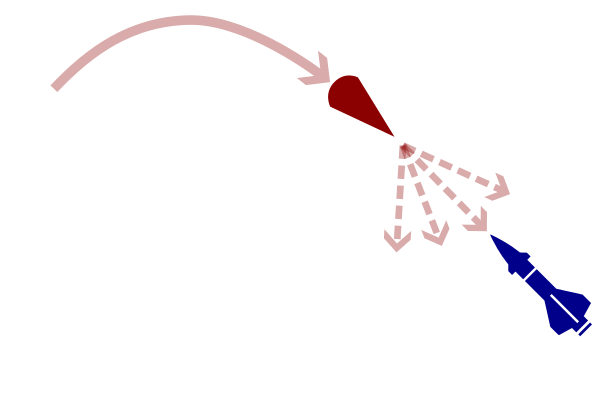
- Example context: air defense against maneuvering attackers.
- Traditional approach: assume a model for the attacker, use optimal control to intercept.
- Attacker can exploit this approach by behaving unpredictably (a form of deception).
- If, instead, we play a Nash equilibrium strategy for a zero-sum game, the strategy is robust in the sense that we will do no worse if the other player changes their strategy.
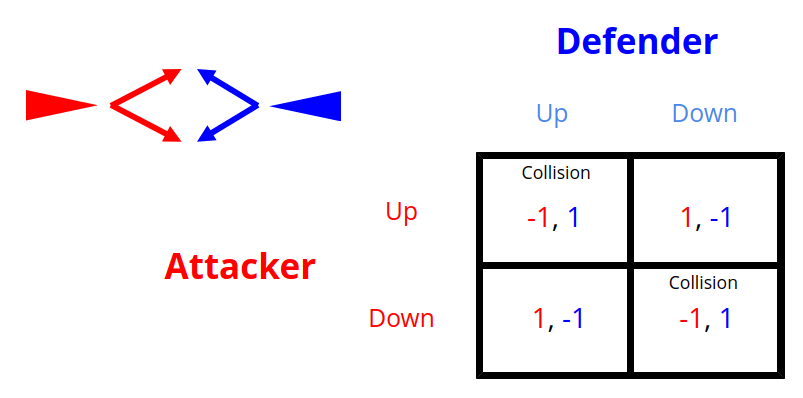
Why Game Theory?
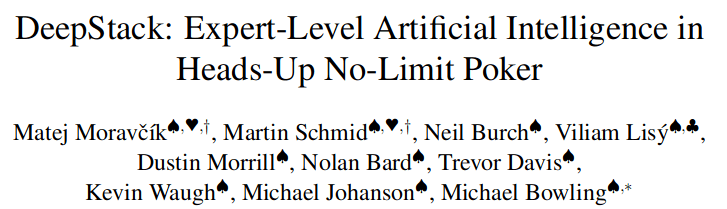
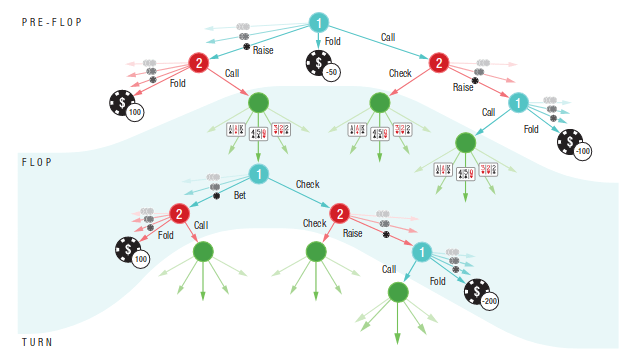
Is a Nash equilibrium strategy a good choice in real life against humans?
Yes! Example: Superhuman play in poker with deception through bluffing.
Part 1: Online Planning in POSGs

Tyler Becker
Joined DECODE AI project Fall 2024
Partially Observable Stochastic Games (POSGs)
- Environment has state \(s \in S\)
- Agents act simultaneously with \(a^i\) forming joint action \(\mathbf{a}\)
- State transitions according to \(T(s' \mid s, \mathbf{a})\)
- Each agent receives reward \(R^i(s, \mathbf{a}, s')\)
- Each agent receives an observation \(o^i\) with distribution \(Z(o^i \mid \mathbf{a}, s')\)
State space \(S\)
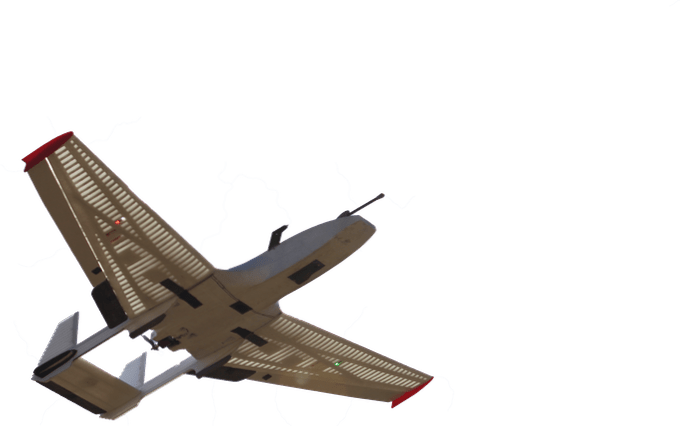
Actions
\(\mathbf{a}\)
\(a^1\)
\(a^2\)
\(a^n\)
Environment with
shared state \(s\)
Policy \(\pi^1\)
Policy \(\pi^1\)
Policy \(\pi^n\)
\(\vdots\)
Observations
\(\mathbf{o}\)
\(o^1\)
\(o^2\)
\(o^n\)
\(S = \mathbb{R}^{12}\)
\(\times \mathbb{R}^{12}\)
\(\times \mathbb{R}^{\infty}\)
POSGs: Challenges and Existing Tools
- Large state spaces
- Partial observations
- Strategic opponents
- Deception and counter-deception
- Our approach: Build on these three tools
| Tool | Good At | Missing |
|---|---|---|
| POMDP* solvers | State uncertainty | Strategic opponents |
| EFG** Solvers | Strategic opponents | Probabilistic beliefs |
| AlphaZero | Learned search | Simultaneous moves |
* A POMDP (Partially Observable Markov Decision Process) is a single agent POSG (much easier)
** EFG = Extensive Form Game
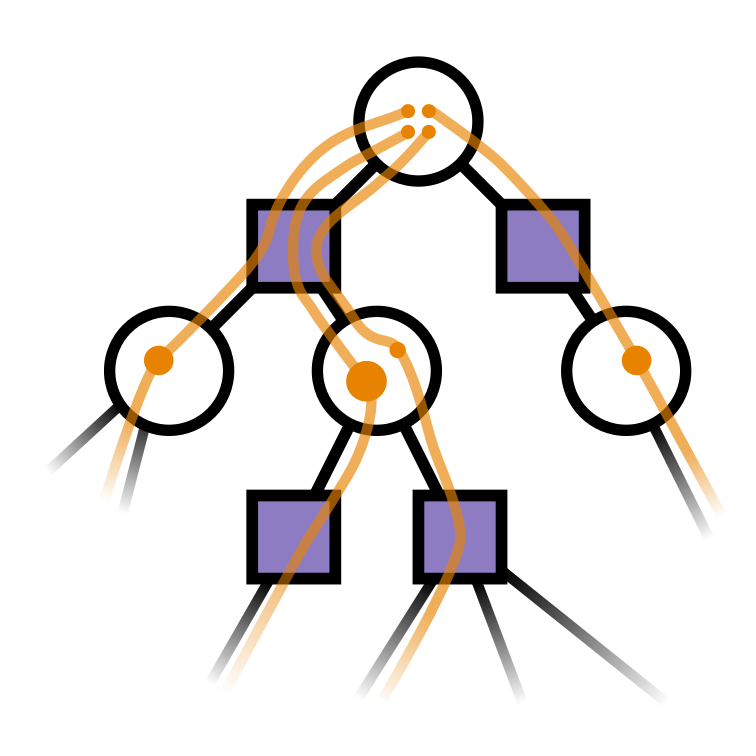
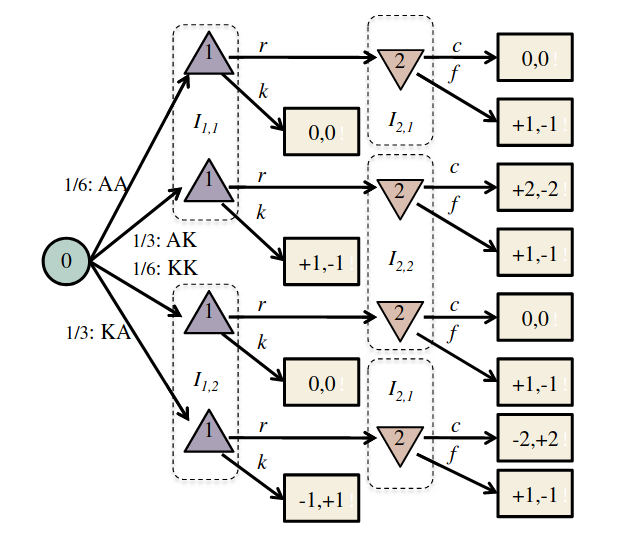
Image: Russel & Norvig, AI, a modern approach
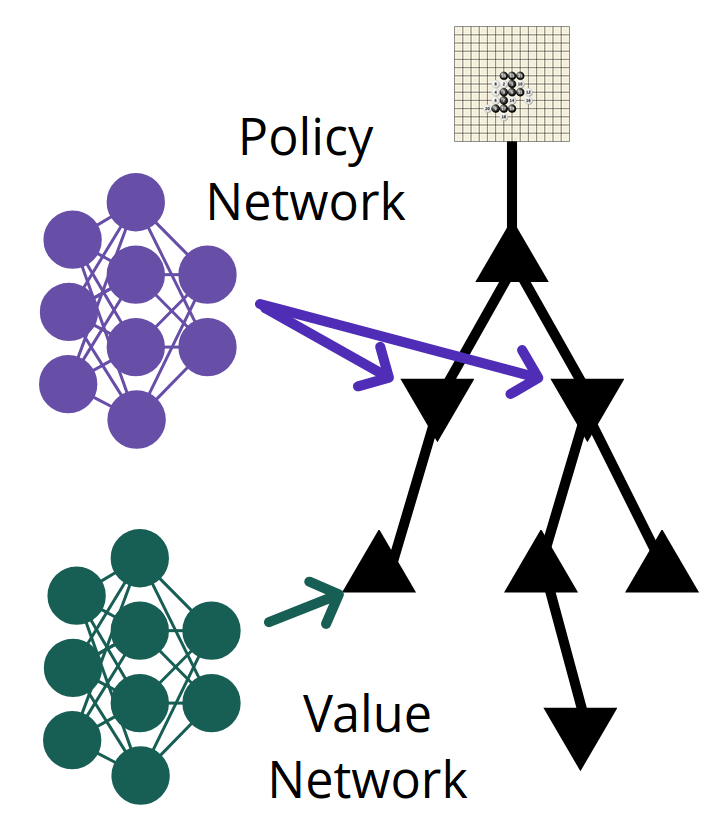
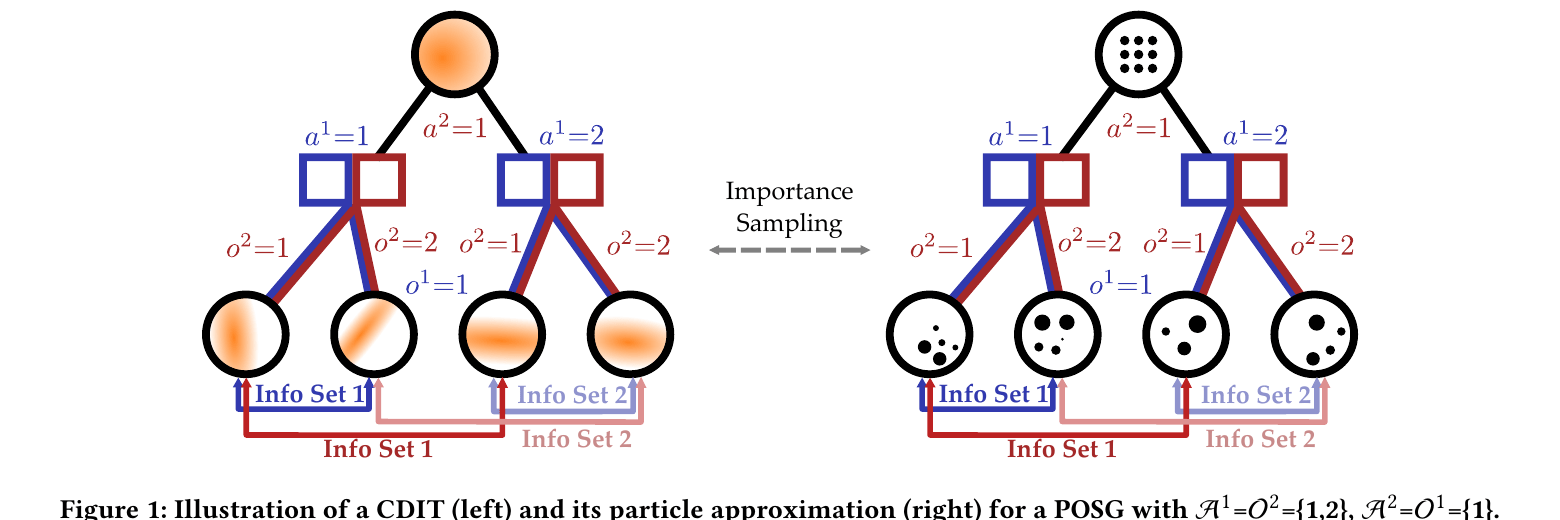
- CDIT (conditional distribution infoset trees) = particles + information sets
- Particles approximate hidden state
- Information sets preserve strategic uncertainty
- CFR (counterfactual regret minimization) searches for low-exploitability policies
Particle-Filter POSGs
Test Environment: Partially Observable Tag
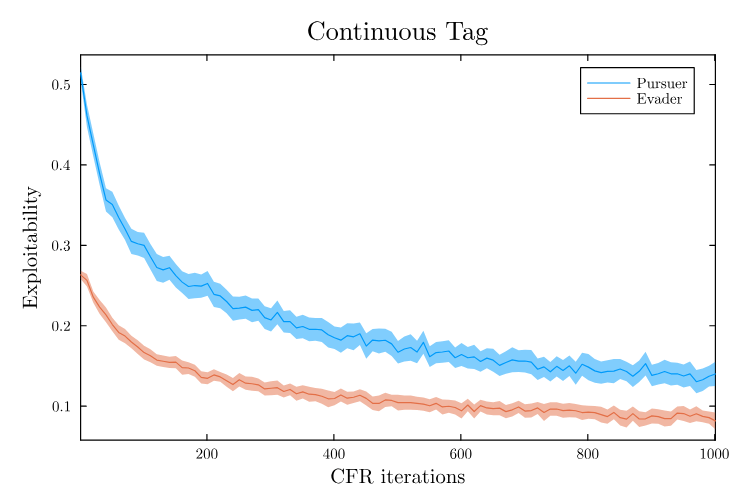
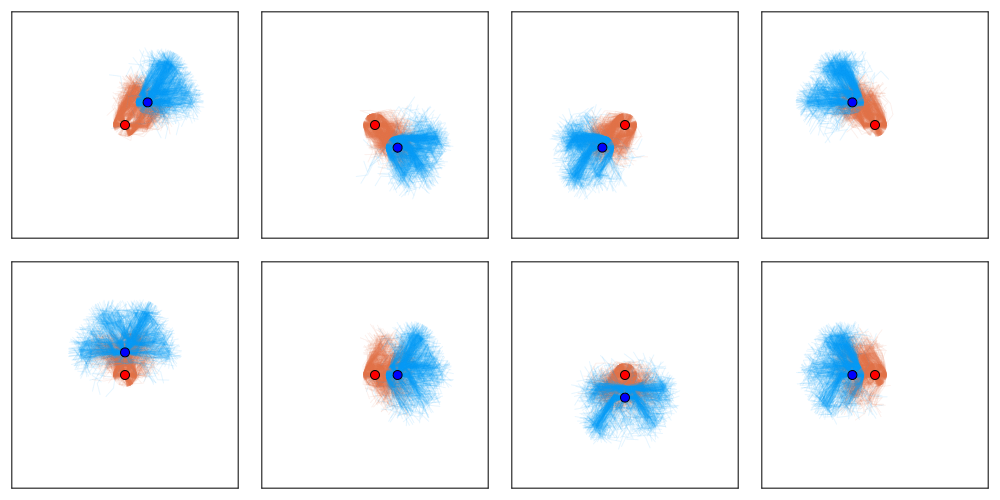
[Becker & Sunberg, AAMAS 2025]
- Equilibrium policies are stochastic and hide intent
- Exploitability measures vulnerability - demonstrably decreases
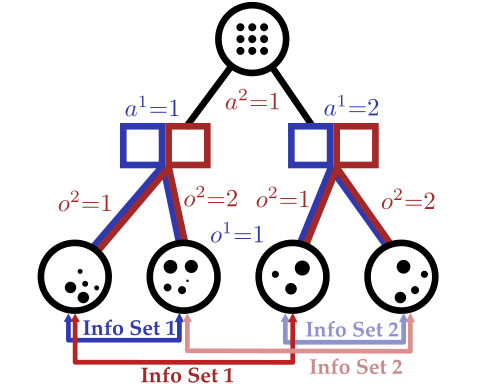
What the CDIT Gives Us
[Becker & Sunberg, AAMAS 2025]
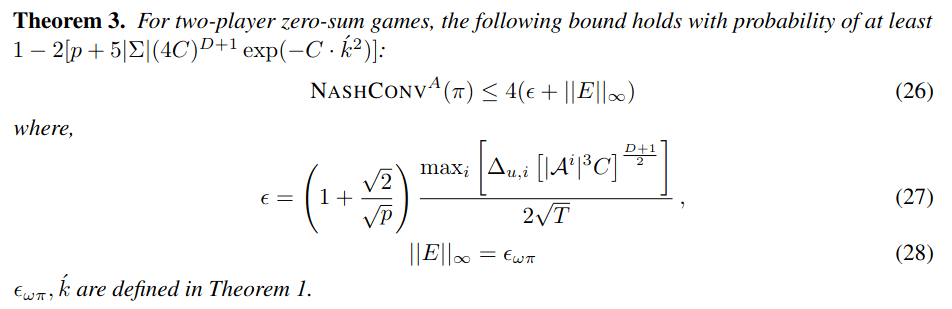
- Equilibrium search without state enumeration
- Continuous-state POSG planning
- Probabilistic exploitability bounds
- No direct dependence on state space size
Combining with Learning: Simultaneous Alpha Zero
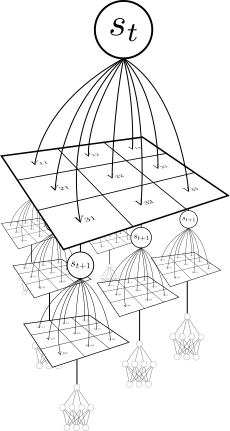
- AlphaZero assumes turn-taking
- Markov Games (e.g. POSGs) move simultaneously
- Each state becomes a matrix game
- Search improves both players' policies
Alpha Zero
SimultaneousAlpha Zero
(Ours)
Search Improves Robustness
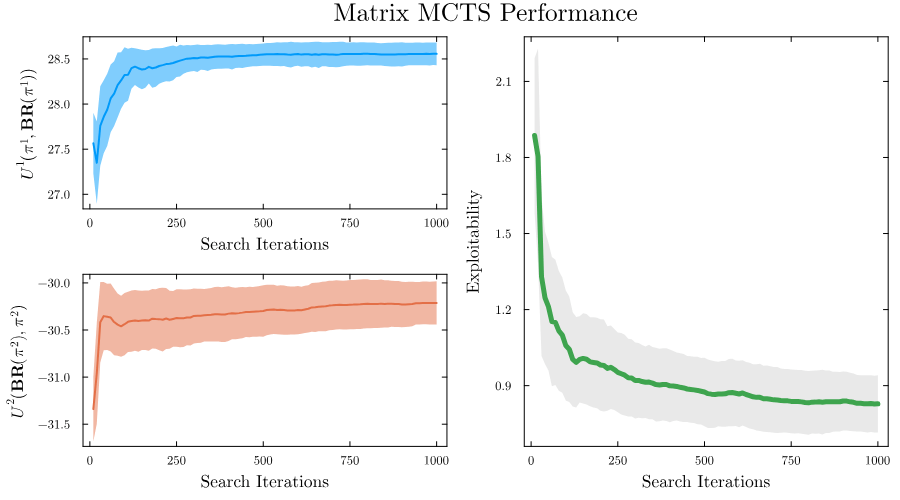
- Best-response value improves; exploitability falls
- Mixed actions prevent exploitation
- Deeper search provably reduces exploitability

Counter-Deception in SDA
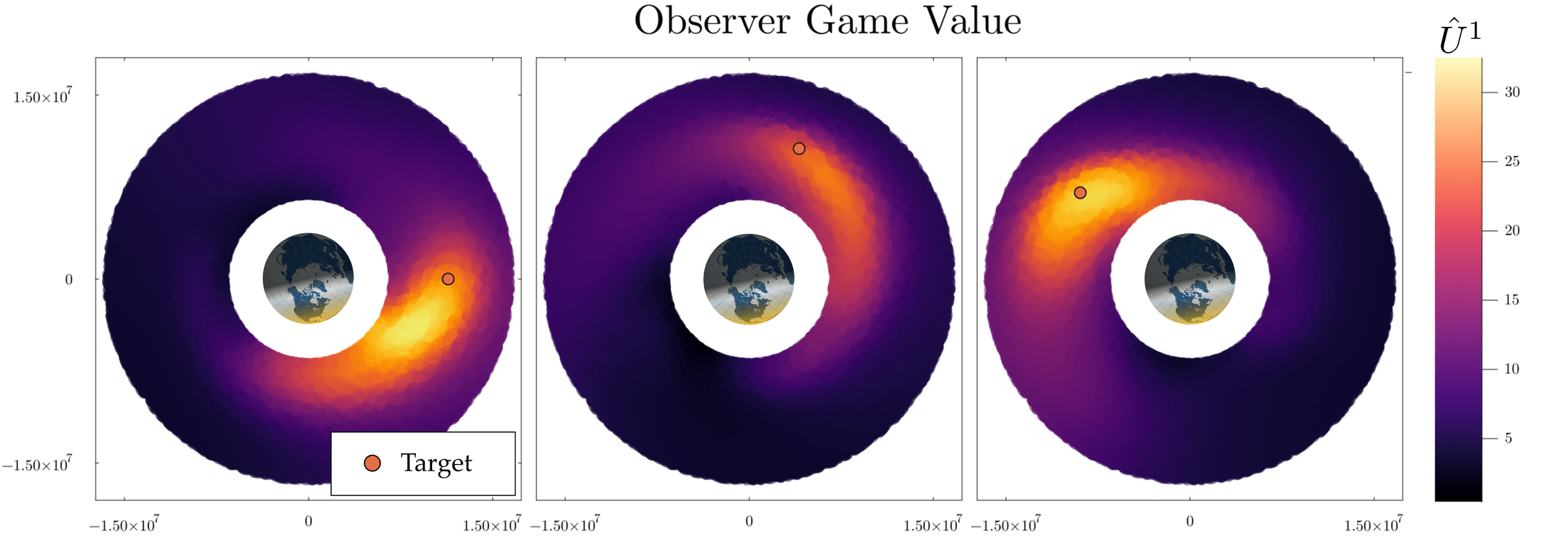
- Target exploits eclipse and occlusion
- Observer learns sensing geometry and robust manuevering strategies
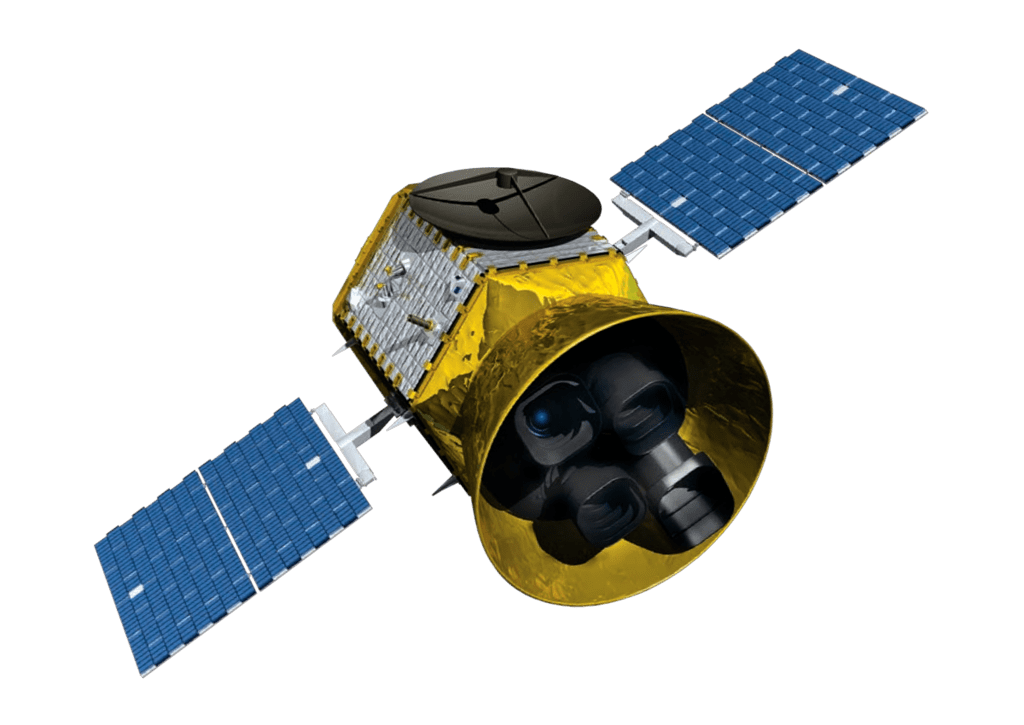
- Observer satellite seeks well-illuminated vantage-points of target satellite
Part 2: Optimal Deception on Shared Channels
Mel Krusniak
Joined DECODE AI project Jan. 2026
Motivation: Informed Pursuit-Evasion
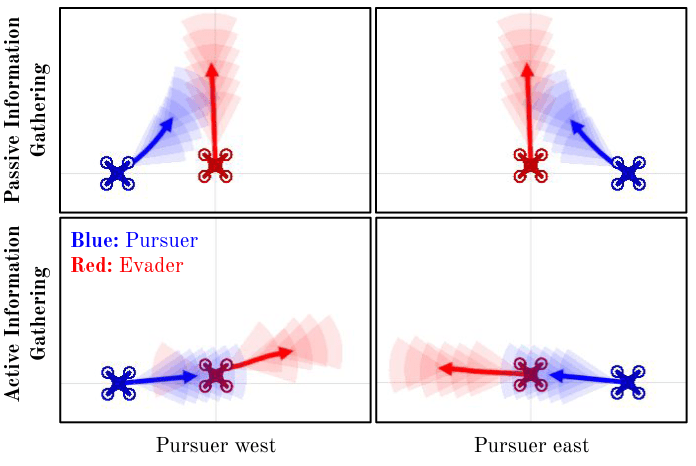
Past work: How do we teach adversarial agents in trajectory space to hide and seek information about each other?
Present work: How do we teach a higher-level broadcaster to publicly share the "right" information with an ally?

Goal: Optimal Informer
Behavior

Consider a three player interaction with one player at a higher informational level.
- Pursuer, Evader: Competition with side goals, acting based on semi-public information.
- Informer: Sees the full state. Determines what semi-public information is broadcast.
Research thrust: Automatically choose what information to broadcast, what channel to use, and how precisely to convey it.
Preliminary Methods
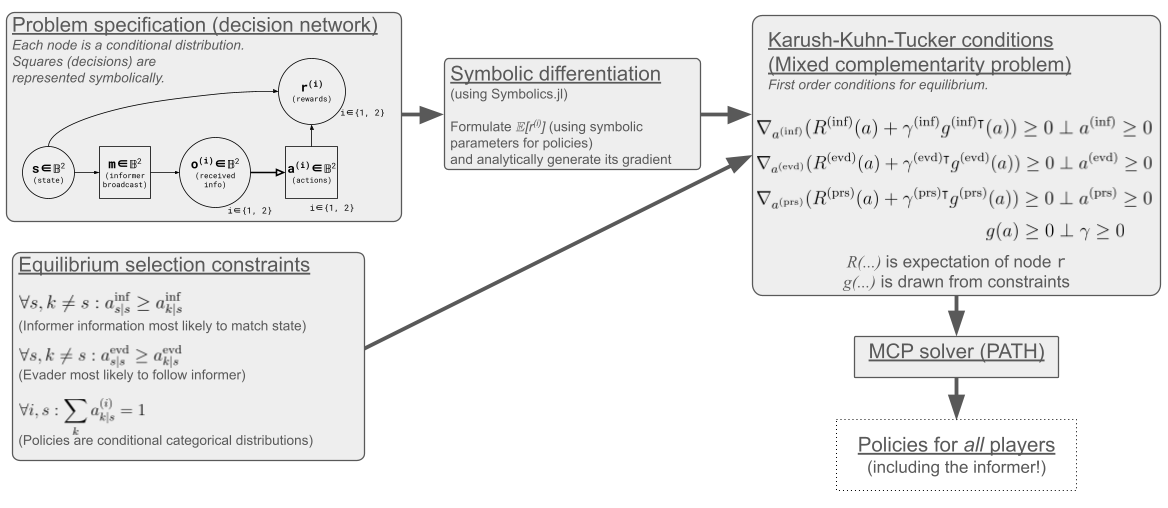
"When should I lie?"
(or "what channels are safe?")
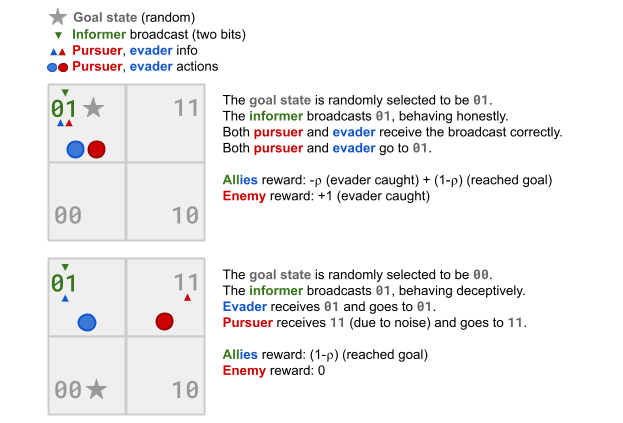
Test environment: Discrete tag in a 2x2 grid.
Four states, two bits of information.
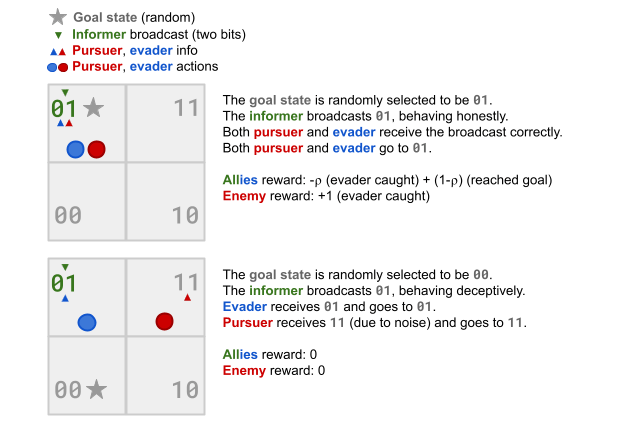
"When should I lie?"
(or "what channels are safe?")
Test environment: Discrete tag in a 2x2 grid.
Four states, two bits of information.
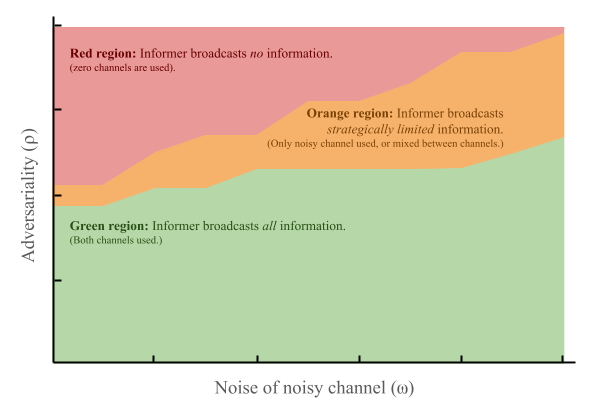
- Adversariality: Evader has a side goal.
It seeks a goal state with weight (1-⍴).
Goal is random, but seen by the informer.
- Noise: Pursuer has worse observations.
The second bit (or "channel") is perturbed with probability ⍵.
\[r^{(\text{evd})}(a) = (1 - \rho) \; r^{(\text{evd})}_{\text{reach\_goal}}(a) + \rho \;r^{(\text{evd})}_{\text{avoid\_psr}}(a)\]
Long Term Goals
This is one example of an "information game." Others of interest include:
- Channel takeover prevention / "confirm-then-commit" tactics
- Dogwhistle / "double speak" identification
- Information denial via mixed strategies
Game theory, machine learning, and control theory all contribute useful tools, but converting between formalizations is fraught, error-prone, and inefficient.
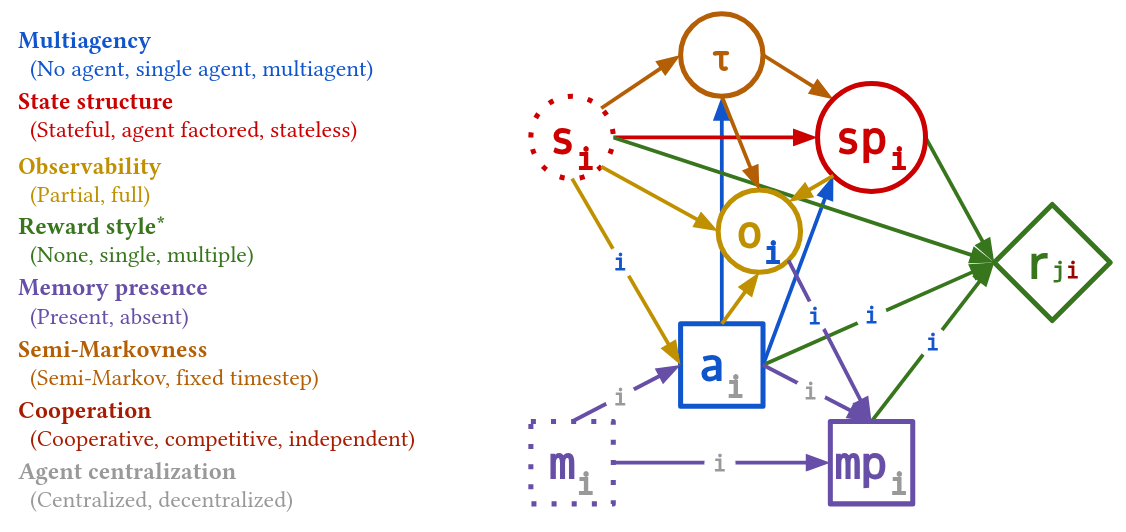
Decisions.jl: Representing and solving games with arbitrary decision networks
Thank You!




(Opinions are my own)